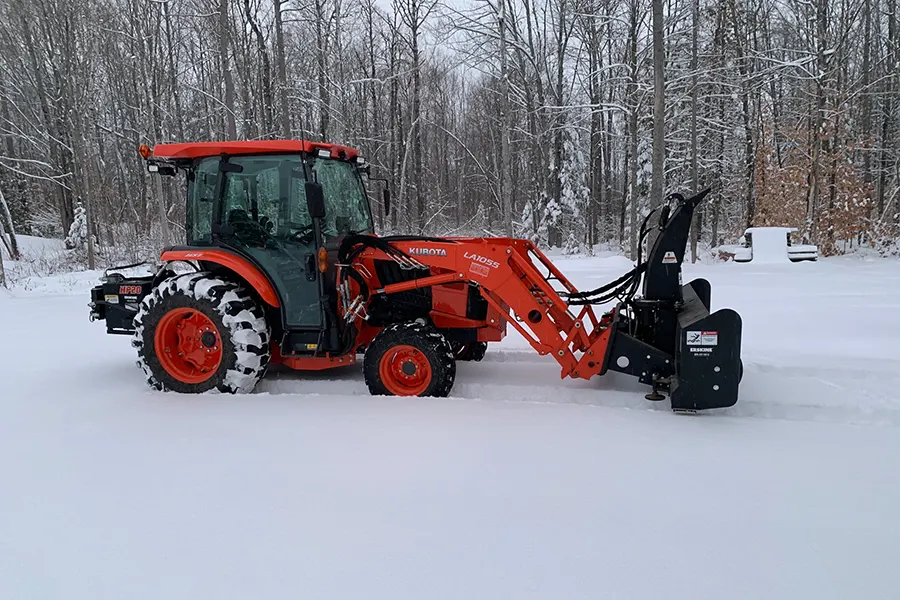
Can you run a skid-steer snow blower on a tractor? Yes—provided your tractor can safely carry the blower and you have a hydraulic power source that meets the blower’s requirements. Most tractor loader hydraulic circuits do not provide the continuous flow that a hydraulically driven skid-steer snow blower needs. A PTO hydraulic power pack is often the most practical solution.
In this guide, we’ll explain how the system works, how to check compatibility, and how to mount and connect a skid-steer snow blower to a tractor. We’ll use the Victory HPP100 PTO Hydraulic Power Pack—rated at 21 GPM continuous hydraulic flow at 540 PTO RPM—as an example. The principles also apply to compatible snow blowers from other manufacturers.
What You Need to Run a Skid-Steer Snow Blower on a Tractor
- A tractor with a compatible front loader: The loader must be rated to safely lift and carry the snow blower throughout its operating range. Account for the blower’s weight, attachment geometry, ballast, and the tractor manufacturer’s loader limitations.
- A skid-steer quick-attach (SSQA) interface: The loader must have an attachment interface compatible with the blower’s mounting plate, or a properly rated adapter.
- A 540 RPM rear PTO and suitable three-point hitch: These drive and support a PTO power pack such as the HPP100. The Victory HPP100 requires a minimum of 45 PTO HP. Verify PTO shaft fit and hitch compatibility.
- Enough hydraulic flow and pressure: The power pack’s continuous output must fit the blower manufacturer’s required hydraulic flow range and pressure limits.
- Pressure, return, and case-drain plumbing: Where the snow blower motor requires a case drain, it must have its own suitable low-backpressure path to the reservoir.
- Appropriate hose routing and blower controls: The hydraulic lines must reach the front attachment through the loader’s full motion without stretching, pinching, chafing, or contacting moving parts. Any electrical chute controls must also be connected according to the blower’s instructions.
Why Your Tractor May Need a PTO Hydraulic Power Pack
A skid-steer snow blower typically uses a hydraulic motor to drive its snow-clearing mechanism. While a tractor may have rear remote hydraulic outlets or a third-function loader circuit, those outlets are not necessarily designed to deliver the high, sustained hydraulic flow required by the blower. The tractor’s advertised total hydraulic pump capacity also may include flow reserved for steering and other functions; it is not automatically the flow available to an attachment.
A PTO-driven hydraulic power pack solves this problem by using the tractor’s rear power take-off to drive a separate hydraulic pump. Instead of relying on the tractor’s loader hydraulic circuit to run the snow blower, the power pack supplies oil through its own hydraulic system.
The Victory HPP100 provides 21 GPM of continuous flow at 540 PTO RPM and incorporates a hydraulic oil reservoir, oil cooler, and connections for pressure, return, and a dedicated case drain. It is supplied with long hydraulic hoses intended to reach a front-mounted attachment. This avoids the custom reservoir modification that can be necessary when using power packs without a dedicated case-drain connection.
Step 1: Check Snow Blower and Tractor Compatibility
Match Hydraulic Flow (GPM)
Hydraulic flow determines how quickly the blower’s hydraulic motor can turn. Check the blower manufacturer’s specified operating range—not just a generic description such as “standard flow.” A 21 GPM power pack is suitable only when 21 GPM falls within the blower’s approved operating range, subject to the other requirements below. A blower that requires substantially more flow may operate too slowly or fail to perform adequately; one with a lower maximum flow may need properly engineered flow control.
For example, the current Victory SS-SB72H, equipped with a 107 cc/rev piston motor and specified for 18–24 GPM, is a compatible hydraulic-flow match for the HPP100’s 21 GPM output. This example does not mean that every 72-inch snow blower, or every blower marketed for a skid steer, has the same requirements.
Confirm Hydraulic Pressure
Flow and pressure are different specifications. Flow (GPM) influences motor speed; pressure (PSI) reflects the resistance the hydraulic system must overcome and determines available torque in combination with motor displacement. Verify that the blower’s allowable pressure, the power pack’s operating pressure and relief setting, and the ratings of its hoses, couplers, and fittings are compatible. Do not raise a relief setting in an attempt to compensate for inadequate flow.
Check PTO Horsepower and Loader Capacity
The tractor must have enough available PTO horsepower to drive the hydraulic pump under load. Do not confuse engine horsepower with PTO horsepower: the latter is the useful figure for a PTO-driven attachment. The Victory HPP100 requires a minimum of 45 PTO HP. Confirm your tractor meets this minimum using its PTO horsepower rating, not its engine horsepower rating. Also verify that the loader can handle the blower’s weight and center of gravity, and use ballast as directed by the tractor manufacturer.
Check the Case Drain
Many hydraulic snow blower motors have a separate case-drain line. It carries internal motor leakage back to the reservoir and helps prevent excessive pressure inside the motor housing. It is not interchangeable with the main return line. Where a case drain is required, connect it to the power pack’s dedicated case-drain connection and verify that the complete path meets the motor manufacturer’s maximum allowable case-drain backpressure. Never cap an active case drain or combine it with a restricted pressure or return circuit.
Step 2: Mount the Snow Blower on the Front Loader
- Park the tractor on firm, level ground, apply the parking brake, shut down the engine, and secure the equipment against movement.
- Confirm that the loader’s SSQA carrier matches the snow blower mounting plate and that the loader is appropriately rated.
- Approach and pick up the blower in accordance with the tractor and loader manufacturer’s procedure, then fully engage and inspect both attachment locking mechanisms.
- Check that the blower remains secure and maintains adequate clearance through the intended loader travel and tilt range.
- Set the blower’s skid shoes and operating position in accordance with its manual before clearing snow.
Important: A skid-steer-compatible mounting plate does not, by itself, establish that the blower is safe for a particular tractor. Loader capacity, ballast, visibility, and stability still need to be evaluated.
Step 3: Install the PTO Hydraulic Power Pack
- Attach the HPP100 to the tractor’s three-point hitch and secure the hitch pins and retaining hardware.
- With the tractor stopped and PTO disengaged, connect the PTO driveline in accordance with the HPP100 and tractor manuals. Confirm shaft engagement, telescoping clearance, guarding, and operating angles throughout the hitch’s permitted movement.
- Position and secure the power pack as specified by its manufacturer, maintaining clearance for the PTO driveline, cooling airflow, and hydraulic lines.
- Check the reservoir’s hydraulic oil level and confirm the correct oil specification using the HPP100 operating instructions. Inspect hoses, fittings, and the cooler before startup.
Never work near a rotating PTO shaft. Keep all shields in place, stop the tractor engine before making adjustments, and do not exceed the HPP100’s rated 540 PTO RPM.
Step 4: Connect the Three Hydraulic Lines
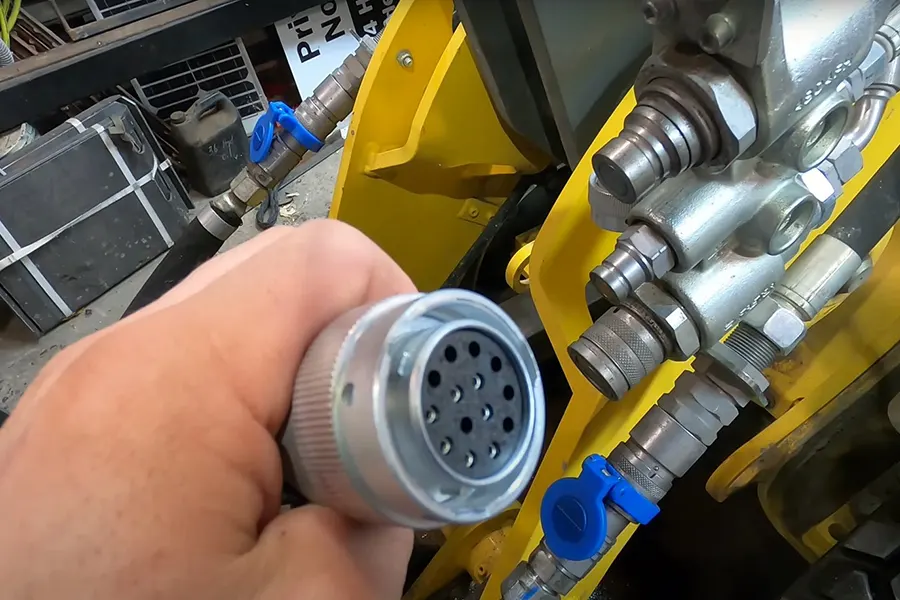
The HPP100 uses three hydraulic connections for a compatible snow blower: pressure, return, and case drain. The supplied long hose set uses 1/2-inch pressure and return hoses and a 3/8-inch case-drain hose. Confirm the actual coupler types and sizes on the blower before attempting to connect them; compatible flow and hose diameter do not guarantee that two couplers will mate.
| Connection | Purpose | Key check |
|---|---|---|
| Pressure (P) | Delivers oil from the power pack to the blower’s motor/circuit | Correct pressure port, coupler, and pressure rating |
| Return (T) | Returns main circuit oil to the power pack | Correct return port and acceptable backpressure |
| Case drain (CD) | Returns internal motor leakage to the reservoir | Dedicated low-backpressure connection; no blockage |
- Shut down the tractor, disengage the PTO, and relieve hydraulic pressure according to both equipment manuals before connecting or disconnecting any hydraulic line.
- Clean and inspect all mating couplers. Identify the pressure, return, and case-drain connections on both the power pack and the blower. Do not rely on hose appearance alone.
- Connect pressure to pressure and return to return using the specified matching connectors.
- Connect the blower’s required case drain to the HPP100’s dedicated case-drain connection. Ensure it is fully seated and unobstructed.
- Route and secure the hoses from the rear power pack to the front-mounted blower, leaving enough slack for steering, loader lift, and tilt. Keep them clear of tires, pinch points, the PTO driveline, hot surfaces, and sharp edges. Use protective sleeves and suitable supports where required.
- With the engine off, check the full intended range of loader movement for hose strain and interference before proceeding.
Do not modify the blower’s valve block, remove its factory hose fittings, or drill a new fitting into a hydraulic reservoir simply to follow this guide. If your blower’s couplers or circuits differ from the HPP100’s connections, identify the correct adapter or hose arrangement using the manufacturers’ specifications before operation.
Step 5: Connect Chute Controls and Check the System
Some snow blowers have an electrically controlled discharge chute or deflector. If yours does, install its control harness and power supply following the blower manufacturer’s wiring instructions, including voltage, fuse protection, and cable routing. The HPP100 supplies hydraulic power; it does not automatically replace a blower’s separate chute controls.
Before starting, verify the hydraulic oil level, all three hose connections, the PTO driveline and guards, loader attachment locks, safe hose clearance, and the operating instructions for both units. Confirm the HPP100’s control-lever position and required startup sequence in the current operating instructions. Keep everyone clear of the blower intake, impeller, and discharge area.
Step 6: Start, Test, and Operate the Snow Blower
Use the manufacturer’s prescribed startup procedure for your particular tractor, power pack, and blower. In general, the first run should be a controlled, no-load system check before clearing snow. Start with the tractor at the PTO engagement speed permitted by its manufacturer; engage and set the HPP100’s hydraulic controls only in the sequence and positions specified by its manual. Increase tractor speed only as instructed, without exceeding 540 PTO RPM.
Confirm that the blower rotates in its intended direction, the chute controls work properly, and the system runs without unusual noise, vibration, leaks, or excessive heat. If anything appears abnormal, disengage the system and shut down before inspecting it. Never loosen a fitting to purge air while the pump is running; pressurized hydraulic oil can penetrate skin and cause serious injury. Follow the manufacturers’ designated priming and air-purging procedures instead.
Once the system passes its initial checks, begin clearing snow at a manageable travel speed. Adjust forward travel to snow depth and density, avoid forcing the blower into hidden obstacles, and monitor performance and oil temperature. Always stop and isolate the equipment before clearing a blockage. Do not reach into the auger or discharge chute, even after shutdown, until all moving parts have completely stopped.
Common Problems and What to Check
| Symptom | What to check |
|---|---|
| Blower turns slowly | Actual delivered flow, PTO speed, excessive hose restriction, and whether the blower requires more than 21 GPM |
| Blower lacks power under load | Available PTO horsepower, hydraulic pressure under load, relief-valve operation, and snow/auger obstruction |
| Motor seal leaks or case drain concerns | Correct dedicated case-drain connection and measured case-drain backpressure against motor limits |
| Hydraulic oil overheats | Cooler airflow, oil level, sustained load, return-line restriction, and operating pressure |
| Hoses leak or won’t connect | Coupler profile, size, pressure trapped in lines, damaged seals, and fully engaged connections |
| Chute doesn’t respond | Blower’s separate electrical power, fuse, controller, wiring, and applicable chute hydraulics |
Never search for hydraulic leaks with your hands. Use a suitable inspection method after following the equipment manufacturer’s safety procedures; suspected hydraulic injection injuries require immediate emergency medical care.
Frequently Asked Questions
Can I use my existing skid-steer snow blower on a tractor?
Often, yes. The tractor must have a compatible and adequately rated front-loader mount, and you must provide the blower with the flow, pressure, and hydraulic connections it requires. The blower does not have to be manufactured by Victory to use a compatible PTO hydraulic power pack.
Why not connect the blower to my tractor’s rear remotes?
Many tractors do not deliver enough continuous auxiliary hydraulic flow to operate a skid-steer snow blower effectively. If your tractor does meet every requirement—including flow, pressure, return backpressure, and case drain—it may be possible to use its hydraulic circuit without a separate pack. Check the actual available flow, not just the tractor’s total pump rating.
Does the HPP100 work with other snow blower brands?
Potentially. The key is that your blower’s hydraulic flow range includes 21 GPM and that its pressure, couplers, case-drain requirements, mounting, and tractor requirements are compatible. Provide the blower’s make, model, and motor specifications to confirm the setup before purchasing.
Is a case-drain line really necessary?
If the blower’s motor manufacturer specifies a case drain, yes. A dedicated case drain protects the motor by keeping housing pressure within its allowable limit. The HPP100 includes a dedicated case-drain connection, but the hose and coupler arrangement must still suit the blower.
Will 21 GPM run any “standard-flow” snow blower?
No. “Standard flow” is a broad category, not an exact specification. Always check the individual blower’s published GPM range. The HPP100 delivers 21 GPM continuous at 540 PTO RPM; the blower must be suited to that output.
Final Thoughts
Running a skid-steer snow blower on a tractor is entirely practical when you solve two separate challenges: mounting the blower safely to the front loader and supplying the correct hydraulic power. A PTO hydraulic power pack lets a suitable tractor deliver hydraulic power independently of its existing loader circuit.
With a 45 PTO HP minimum tractor requirement and 21 GPM continuous output at 540 PTO RPM, an integrated oil cooler, and dedicated pressure, return, and case-drain connections, the Victory HPP100 PTO Hydraulic Power Pack provides a straightforward starting point for owners of compatible hydraulic snow blowers—including those built by other manufacturers. If you’re unsure whether your blower is a match, contact Victory Tractor Implements with the blower make and model, required GPM, pressure specifications, and coupler details before ordering.
Questions about your setup? Call Victory Tractor Implements at (562) 534-8182 or email sales@etractorimplements.com.
Safety disclaimer: This article provides general guidance and does not replace the tractor, loader, snow blower, or hydraulic power pack operator’s manuals. Follow all manufacturer-specific installation, operating, maintenance, and safety instructions. Verify compatibility before connecting or operating equipment, and consult a qualified hydraulic technician when specifications or connections are uncertain.